
Seeing Differently
A Practical Guide to Seeing What Others See
A Simple Question
What is 11 + 2?
Think about this question and what your answer might be to it before proceeding to the next tab.
Do you have an Answer?
Are you certain?
Before you move forward, take a moment to reconsider your response.
- What assumptions are you making?
- What system are you using?
- What are you taking for granted?
- Could the question be interpreted differently?
Do you now see another possible answer?
There is no penalty for revising your thinking.
You probably answered 13. After all, on a standard number line, starting from 11 and adding 2 takes you to 13.
You were probably interpreting the question as solving the equation:
11 + 2 = x
In that interpretation, the value of x is clearly 13.
In mathematics, the equal sign "=" means “has the same value as.”
But something interesting happens whenever we read an expression like this. Before we ever calculate anything, we quietly decide how the symbols should be understood.
The symbols themselves do not tell us which interpretation to use.
Because of this, a careful thinker might avoid saying simply “13 is the answer.” Instead they might say:
One possible answer is 13.
But some people say the answer is 1.
How could that possibly be correct?
Are we thinking about numbers on a line?
Are we thinking about hours on a clock?
Are we thinking about some other system?
How, then, could any one answer possibly be the only correct response?
- The words in the question did not change.
- The numbers in the question did not change.
- The symbols in the question did not change.
Yet the answer might still change.
Reflection
We are now entertaining the possibility that more than one answer can be valid.
- How many interpretations can you think of?
- Take a moment and really consider the possibilities.
- Think beyond arithmetic.
If the symbols remain the same, but the answer changes, something else must be influencing the result.
Here are a few possibilities people often discover:
- 1 — an analog clock starting at 11 o’clock and moving forward two hours
- XIII — thirteen written using Roman numerals
- 15 — thirteen expressed in base-8 notation
- A question — identifying the grammatical structure of the sentence
- Insufficient information — sometimes the correct response is recognizing that the problem is underspecified
These are only a few examples. Many others are possible.
So now we must ask a deeper question:
What determines how a response makes sense?
Questioning
When the symbols stay the same but the answer changes, something else must be influencing how the problem is understood. What determines how a response makes sense? It could be:
- the rules being used
- the assumptions being made
- the frame of reference
- the system used to interpret the symbols
There is a single word that captures all of these:
Context
Context includes the rules, assumptions, frame of reference and system used to interpret information.
When the context changes, the interpretation can change.
When the interpretation changes, the answer can change as well.
This is why the same expression can produce different answers without any of the language or symbols themselves changing.
Many Ways to Interpret
So far we have seen that the same question can produce different answers depending on how it is interpreted.
But this is not just something that happens in puzzles or wordplay.
It happens constantly in the real world.
People from different disciplines, professions, and experiences often look at the same situation and understand it in very different ways.
In this section, we will explore several examples of how interpretation can change what we believe to be true.
💡 When people disagree, it is often not because they are seeing different facts.
They are interpreting the same situation differently.
A Quick Question
We have now seen that the same information can sometimes lead to different answers.
In the examples we explored, interpretation changed the outcome.
But interpretation does not happen in isolation.
Many factors influence how people interpret what they see, hear, and read.
What factors influence how people interpret information?
💡 These responses are a map of what shapes interpretation:
Here are examples of answers that often appear:
- Academic discipline or field of study
- Professional role and responsibilities
- Culture and social norms
- Prior experience and training
- Goals and incentives
- Language and definitions
- Project requirements and scope
- Time constraints and pressure
- Values and priorities
- Information quality, missing data, and uncertainty
Different Professions
Look back at the list we just generated.
One of the most common influences on interpretation is professional training.
Different fields train people to notice different things.
They also train people to ask different questions.
So even when two people are looking at the same situation, they may be interpreting it through very different professional lenses.
Consider a single situation:
A city wants to reduce flooding in a neighborhood.
- An engineer might focus on drainage capacity, infrastructure constraints, and physical limits.
- An environmental scientist might focus on watersheds, soil infiltration, and ecological impacts.
- An economist might focus on incentives, costs, and how people respond to policy.
- A public health professional might focus on safety, exposure, and downstream health outcomes.
- A community organizer might focus on trust, lived experience, and whether the solution is workable for residents.
Each interpretation is reasonable.
Each one highlights something important.
💡 The disagreement is often not about intelligence.
It is about what each person has been trained to notice and prioritize.
When Systems Collide
Sometimes interpretation differences are not just academic.
Sometimes two teams can do their work correctly and still produce a catastrophic outcome.
One of the most famous examples is the Mars Climate Orbiter.
In 1999, NASA lost a spacecraft because two teams were using different measurement systems.
Context Disaster!
- One set of calculations used English units (pound-force seconds).
- Another set of calculations assumed metric units (newton seconds).
Both teams were following their own procedures.
But the systems were not aligned.
The result was that the spacecraft entered Mars’s atmosphere at the wrong trajectory and was lost.
💡 The key point is not that someone was careless.
The key point is that “correct work” inside one system can fail when another system is assumed.
Project Scope
Interpretation differences also appear in everyday work.
One of the most common sources of misunderstanding is project scope.
A request may sound clear, but different people may interpret that request in different ways.
Imagine a manager giving a simple instruction:
“Build a reporting dashboard for this project.”
That instruction may sound straightforward.
But different people may imagine very different things.
- A software developer might think about data pipelines, APIs, and system performance.
- A project manager might think about timelines, deliverables, and stakeholder expectations.
- An executive might expect a simple visual summary that supports decision making.
Each interpretation is reasonable
Each interpretation reflects a different understanding of what the project requires.
⚠️ If those expectations are never clarified, people can work very hard on the wrong thing.
The work may be technically correct, but it does not solve the problem that others believed was being addressed.
Data Visualization
Data visualizations are designed to help us understand information quickly.
But the same data can lead to very different conclusions depending on how the data are encoded.
This matters most when we confuse two different kinds of data:
- Categorical (nominal). Groups with no natural order (for example: departments, majors, cities, colors).
- Quantitative. Categories with a real order (for example: low–medium–high, strongly disagree → strongly agree).
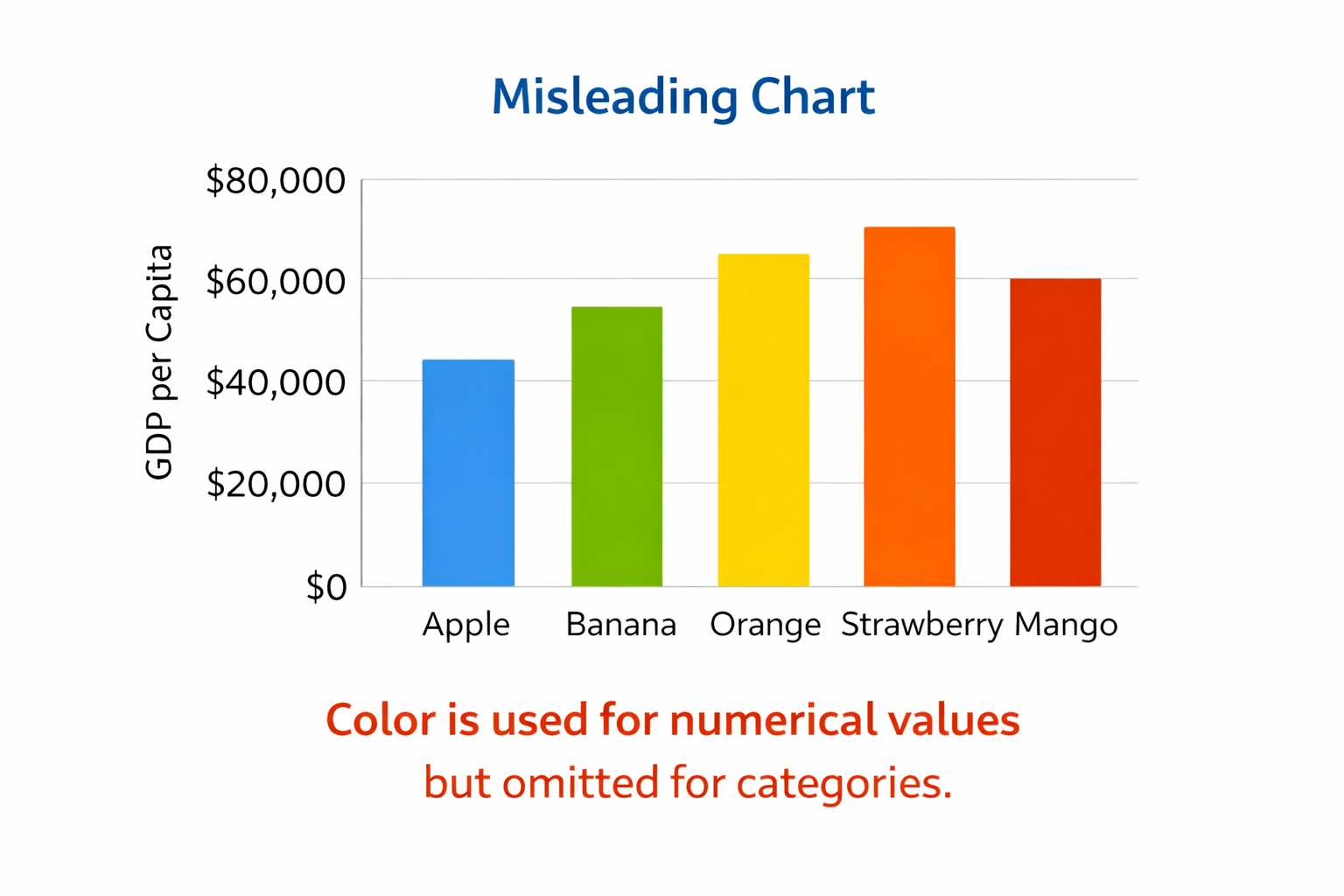
A common visualization mistake is treating categorical groups as if they are ordered.
When that happens, a chart can quietly imply a trend that does not exist.
Example idea: If we plot departments on a line chart, the line suggests that moving from one department to the next has meaning.
But department names are not an ordered scale. They are labels.
The line is not showing a real progression. It is connecting unrelated groups.
So when you see a visualization that appears to show a smooth rise or fall, ask one question first:
Are these categories truly ordered, or are they just different?
If the values are categorical, prefer:
- Bar charts (one bar per category)
- Dot plots (one point per category)
- Small multiples (separate panels per group)
The data did not change.
The interpretation changed because the visualization created the wrong context.
In other words: the chart taught the viewer something that was not actually in the data.
Putting It Together
In the examples we have explored, the information itself did not necessarily change.
What changed was how that information was interpreted.
We saw this in simple puzzles.
We saw it in professional training.
We saw it in engineering systems.
We saw it in everyday project work.
In each case, people were often looking at the same situation but understanding it in different ways.
💡 To understand why this happens, we have to look at something deeper.
We have to look at the context that surrounds the situation.
The Missing Piece
Throughout this lecture we have seen situations where the same information produced different interpretations.
At first this may seem puzzling.
If the information did not change, why did the answers change?
The missing piece is something we rarely stop to examine.
💡 Context surrounding the information is often the missing piece.
Context includes the assumptions, rules, goals, and experiences that shape how a situation is understood.
It defines what counts as relevant, what questions are asked, and what answers seem reasonable.
When the context changes, interpretation can change.
And when interpretation changes, people may arrive at different conclusions even when they are looking at the same facts.
In other words, understanding the context helps us understand why people may see the same situation differently.
Seeing the Pattern
Now that we have introduced the idea of context, the earlier examples begin to look different.
The pattern becomes easier to see.
- 11 + 2 produced different answers because the calculation was interpreted within different systems.
- The phrase all but 9 produced a surprising answer because the wording was interpreted in a particular way.
- Different professions focus on different aspects of the same situation.
- The Mars Climate Orbiter was lost because two teams were working within different measurement systems.
- A project request can fail when people interpret the scope differently.
In each case, the underlying information was not necessarily wrong.
The context surrounding the information was different.
💡 When we understand the context, the situation begins to make sense.
What once looked confusing begins to look clear.
A Simple Habit
So what can we do when we encounter confusion?
A useful habit is to pause and ask a simple question.
⚡ What is the context?
- What assumptions are being made?
- What system or rules are being used?
- What goals or incentives might be influencing the situation?
Very often, confusion begins to disappear when we understand the context.
💡 Understand the Context. See Clearly.
This simple idea can help us navigate disagreements, misunderstandings, and complex problems.
When we pause to understand the context, situations that once seemed confusing often become clear.
Why This Matters
Understanding context is not just a classroom idea.
It affects how people collaborate, communicate, and solve problems.
In science, different disciplines may approach the same problem from different perspectives.
In engineering, teams may design parts of a system using different assumptions.
In organizations, people in different roles may interpret the same information in very different ways.
When context is not shared, confusion is almost inevitable.
⚠ Many disagreements are not really about facts.
They arise because people are working within different contexts.
But when people take time to understand each other's context, communication improves and problems become easier to solve.
💡 Understand the Context. See Clearly.
Often the key to resolving confusion is not changing the information, but understanding the context surrounding it.
What We Learned
During this discussion we explored several situations that initially appeared confusing.
In each example, intelligent people arrived at different conclusions even though they were looking at the same information.
The numbers did not change.
The words did not change.
The facts did not change.
Yet the answers were different.
As we examined these examples more closely, a pattern began to emerge.
💡 The difference was the context surrounding the information.
Once the context became clear, the situation that once appeared confusing began to make sense.
Understanding the context allows us to understand why people may see the same situation differently.
A Habit Worth Keeping
This idea leads to a simple principle that can be useful in many areas of life.
💡 Understand the context. See clearly.
From this principle follow two practical habits.
First: When something seems confusing, pause and ask a simple question.
⚡ What is the context?
Very often, the moment we understand the context, the situation begins to make sense.
Second: When entering a new situation, take a moment to explore the context early.
Doing so often prevents confusion before it begins.
Understanding the context does not remove every challenge, but it often transforms confusion into clarity.
Much of my work, whether in agriculture, science, or teaching, involves helping people understand complex systems more clearly. Learning to ask about context is one of the most useful habits I know.
— Steve Amerige